ENERGY & TECHNOLOGY 24 October 2026
A case for Induction Cooktop
A case for Induction Cooktop
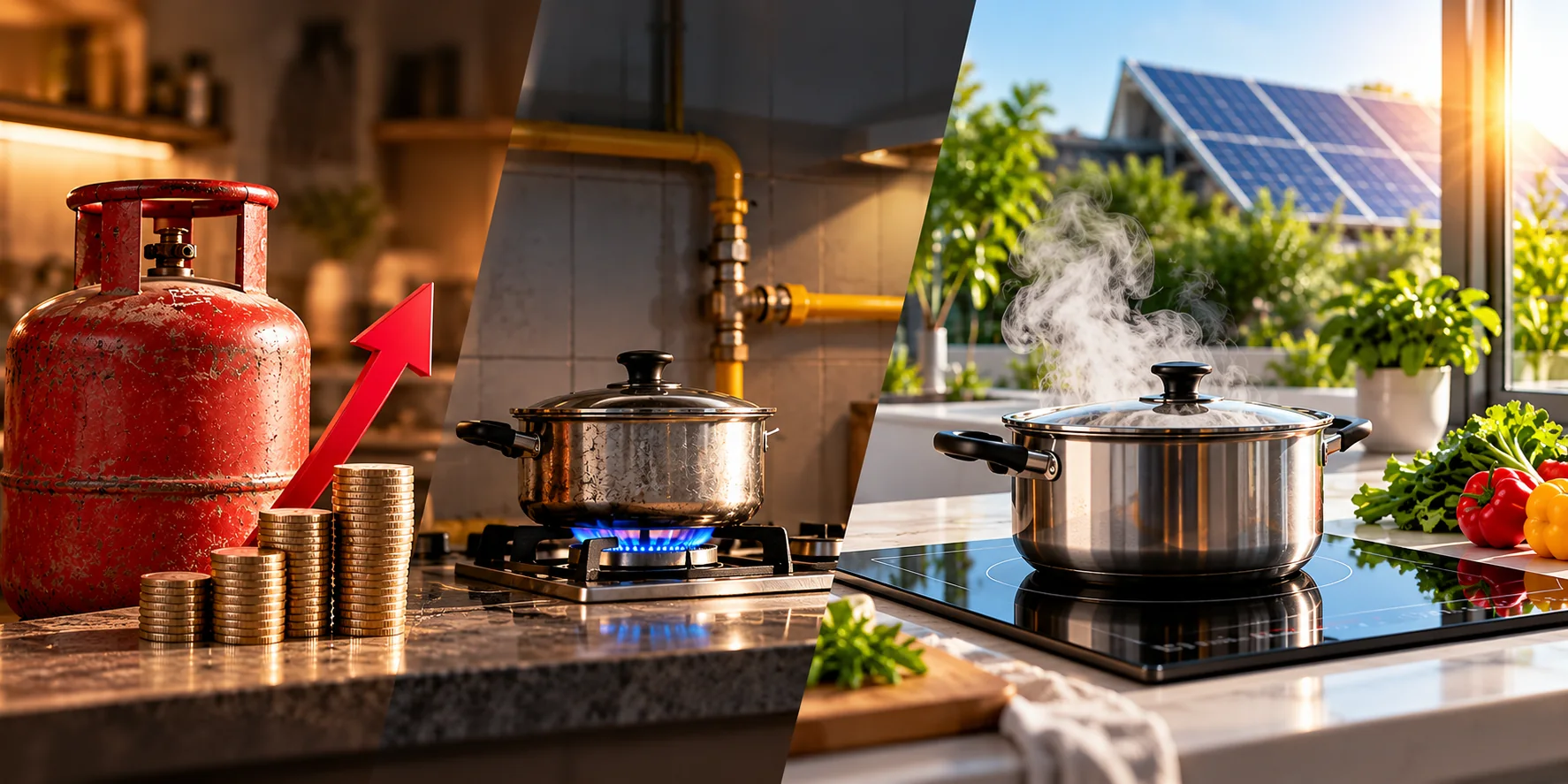
The current geopolitical situation, including the conflict in Iran and the risk of a blockage of the Strait of Hormuz, has pushed global fuel prices higher. For Pakistan, the consequences are direct and increasingly difficult to ignore. Piped gas, once a cheap and reliable source of energy for households, now comes with continuously rising tariffs and frequent load shedding. Meanwhile, a large portion of the population relies on LPG cylinders, whose rising prices are making everyday cooking increasingly expensive.
With LPG cylinder gas now costing around Rs 550 per kg, it is worth reconsidering how we cook. Traditional electric stoves have historically been expensive to operate because their nichrome-wire heating elements are inefficient. Much of the energy they consume is wasted heating the surrounding air and the stove’s surface rather than the cooking vessel itself.
However, a different electric cooking technology has been gaining ground around the world. Induction cooktops are already widely used in China and are rapidly gaining popularity in the United States and Europe.
Unlike conventional electric stoves, induction cooktops use a magnetic field to generate heat directly within compatible metal cooking vessels. Instead of first heating a burner and then transferring that heat to the pot, induction generates heat within the cooking vessel itself. This reduces energy losses and makes induction cooking considerably more efficient than both gas and traditional electric stoves.
More importantly, this difference in efficiency changes the economics of household cooking.
Cost of Heating Food Using an LPG Cylinder
To compare different cooking methods fairly, we need to calculate the cost of useful heat delivered to food rather than simply comparing the prices of LPG, natural gas, and electricity.
Let’s calculate the cost using an LPG price of Rs 550 per kg.
Step 1: Energy Content of LPG
One kilogram of LPG contains approximately 12.8 kWh of energy.
Step 2: Stove Efficiency
Assuming a gas stove efficiency of 45%, a substantial portion of the heat escapes around the cooking pot.
Useful energy delivered to food:
12.8 × 0.45 = 5.76 kWh of useful heat
Step 3: Cost Per Useful kWh
- Price of LPG = Rs 550 per kg
- Useful energy delivered = 5.76 kWh
Cost per useful kWh:
550 / 5.76 = approximately Rs 95.5 per useful kWh
This is the estimated cost of useful heat when cooking with LPG at the assumed price.
Important Note
This calculation does not include:
- Transportation costs
- Time spent arranging a cylinder
- Advance payment for a cylinder
- The risk of gas leakage
- Price fluctuations
When these additional costs and inconveniences are considered, the overall burden of LPG cooking may be even greater.
Cost of Heating Food Using Piped Gas
Piped natural gas is generally cheaper than LPG, but its cost should also be evaluated in terms of the useful heat it delivers to food.
Step 1: Energy Content of Natural Gas
One MMBTU of natural gas contains approximately 293 kWh of energy.
Step 2: Gas Tariff
The assumed average domestic piped-gas tariff, following recent increases, is approximately Rs 3,500 per MMBTU. The actual tariff varies by consumption slab.
Cost per kWh of raw energy:
3,500 / 293 = approximately Rs 12 per kWh
Step 3: Stove Efficiency
Assuming a gas stove efficiency of approximately 50%, the cost of useful heat becomes:
12 / 0.50 = approximately Rs 24 per useful kWh
Important Note
Despite its relatively low cost, piped gas in Pakistan comes with several practical limitations:
- Load shedding in many cities
- Very low gas pressure during winter
- Tariffs that continue to increase year after year
Piped gas is therefore substantially cheaper than LPG and induction in terms of the estimated cost per unit of useful heat, based on these assumptions. However, reliability remains a significant concern, and the financial advantage of piped gas can diminish as tariffs rise.
Cost of Heating Food Using an Induction Stove
Induction stoves are considerably more efficient than LPG and piped-gas stoves because they heat compatible cooking vessels directly through magnetic induction rather than relying on a flame to transfer heat.
Step 1: Electricity Cost
Assume an electricity cost of Rs 50 per kWh. The actual cost varies depending on consumption slab, taxes, and other applicable charges.
Step 2: Induction Efficiency
Induction cooktops have an estimated efficiency of approximately 90%.
Cost of useful heat:
50 / 0.90 = approximately Rs 55.6 per useful kWh
This means that, at the assumed electricity price, induction cooking costs approximately Rs 55.6 per useful kWh of heat delivered to the food.
Unlike LPG, induction does not require the combustion of fuel at the cooking appliance. Its energy costs also become much more attractive when electricity comes from an existing solar power system.
Solar Advantage

If you have a solar system, the economics change dramatically.
During daylight hours, the marginal cost of electricity generated by an existing solar system can be close to zero. This means cooking on an induction stove during periods of surplus solar generation can cost almost nothing in additional electricity.
Even when batteries are used, the cost of electricity may still be lower than the cost of LPG, depending on the system’s installation cost, battery life, efficiency, and usage.
This is one of the major advantages of induction cooking: unlike LPG and piped gas, induction can directly benefit from electricity generated by solar panels.
Comparison Summary: Which Is Actually Better?
Based on the calculations above, the cost difference is significant.
| Cooking method | Assumed fuel or electricity cost | Estimated cost per useful kWh |
|---|---|---|
| LPG cylinder | Rs 550/kg | Rs 95.5 |
| Piped natural gas | Rs 3,500/MMBTU | Rs 24 |
| Induction cooktop | Rs 50/kWh | Rs 55.6 |
| Solar-powered induction | Depends on surplus solar generation | Potentially close to zero marginal cost |
These figures are estimates based on the stated fuel prices and efficiency assumptions, not universal prices for every household.
The comparison reveals several important points.
Induction is substantially cheaper than LPG. At the assumed prices, useful heat from LPG costs approximately Rs 95.5 per kWh, compared with Rs 55.6 for induction. This makes induction approximately 42% cheaper in terms of the cost of useful heat.
Piped gas remains cheaper than induction on paper. At approximately Rs 24 per useful kWh, piped gas has a significant cost advantage under the assumed tariff. However, load shedding, low pressure, and rising tariffs can reduce its practical appeal.
Induction can offer greater reliability than piped gas. In areas where electricity is more consistently available than gas, an induction cooktop can provide a more dependable cooking option. Its reliability still depends on the availability of electricity.
Solar-powered induction can be the cheapest option. Households with sufficient surplus solar generation during the day may be able to cook at a very low additional electricity cost.
In practical terms:
- LPG: Expensive, with additional costs and logistical inconveniences.
- Piped gas: Relatively cheap, but unreliable in many areas and potentially becoming more expensive.
- Induction: Efficient, reliable where electricity is available, cheaper than LPG at the assumed prices, and potentially the cheapest option when powered by surplus solar energy.
With LPG at Rs 550 per kg, the case for induction cooking becomes considerably stronger. Although piped gas remains cheaper in the calculations, households that depend on cylinders have a clear financial incentive to consider switching to induction.
Advantages of Induction Cooktops
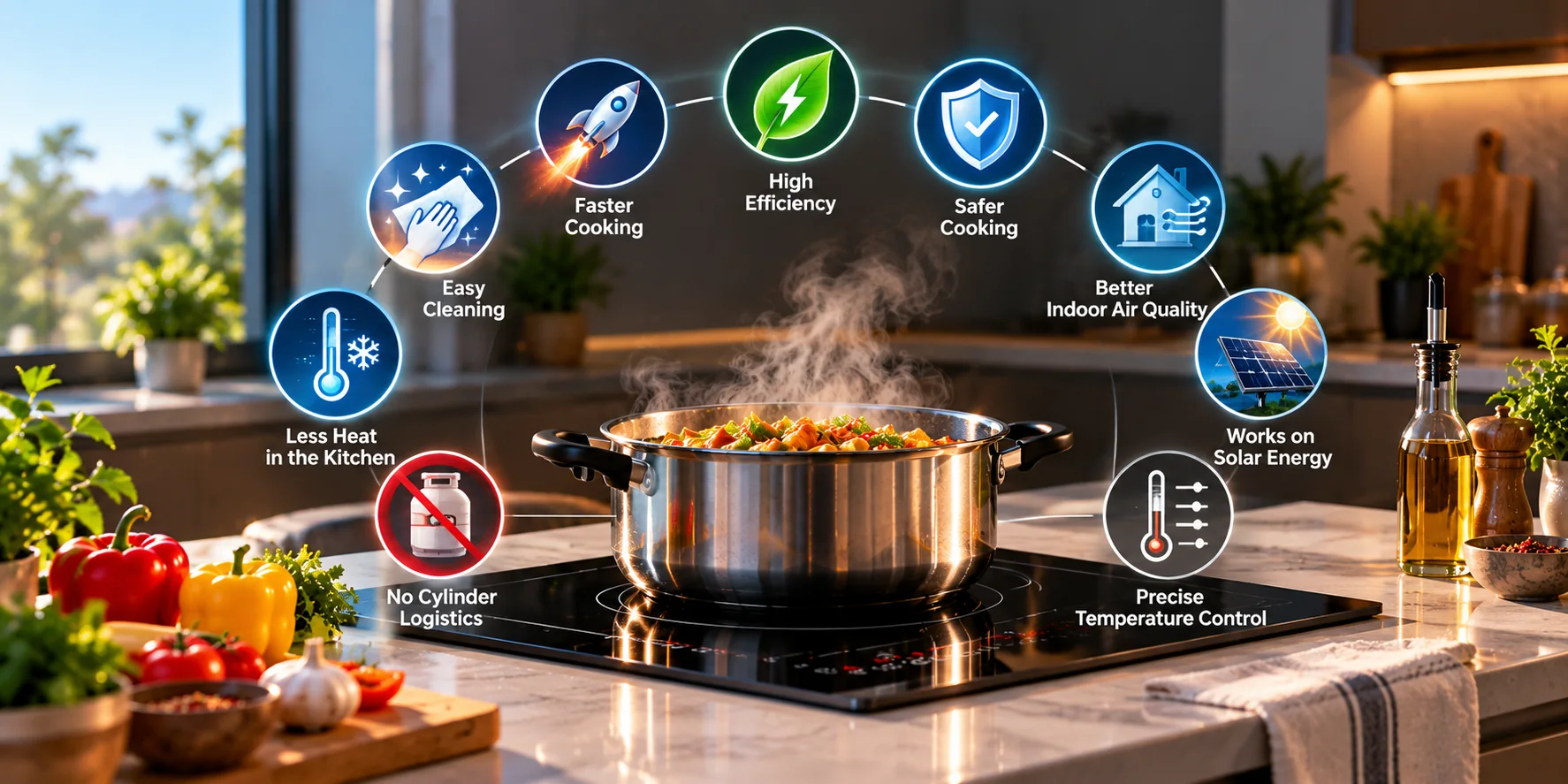
1. Very High Efficiency
Induction cooktops transfer energy directly into compatible cooking vessels using magnetic fields. This minimizes heat losses compared with gas stoves, where a substantial portion of the heat escapes around the pan.
As a result, induction is substantially more energy-efficient than gas cooking, with the potential to be about twice as efficient under typical operating conditions.
2. Faster Cooking
Induction cooktops can boil water 30–50% faster than gas stoves because energy is transferred directly into the cooking vessel instead of first heating the surrounding air and stove components.
This can reduce cooking time and improve energy utilization.
3. Much Safer
Induction cooking eliminates several hazards associated with conventional gas cooking:
- No open flame
- No gas leaks from the cooking appliance’s fuel supply
- No combustion-related carbon monoxide production at the cooktop
- A cooking surface that remains relatively cool compared with conventional electric heating elements
- Automatic shut-off when no suitable pan is detected, on models with this feature
These features make induction particularly attractive for households with children.
4. Better for Indoor Air Quality
Gas stoves produce nitrogen dioxide, carbon monoxide, and particulate matter through combustion. Induction cooktops do not produce combustion emissions at the point of use.
This can substantially reduce indoor air pollution associated with cooking, making induction an attractive option for households concerned about indoor air quality.
5. Works on Solar Energy
Because induction cooktops run on electricity, they can operate using power generated by solar panels.
For households with an existing solar system and sufficient daytime generation, cooking costs can become almost negligible during solar production hours. This advantage is not available with LPG or piped gas, which cannot directly use electricity generated by solar panels.
6. Precise Temperature Control
Induction cooktops offer adjustable power settings, temperature control on models that support it, simmering options, and timers.
These features make it easier to achieve consistent cooking results and maintain controlled heat levels. Conventional gas stoves can make precise low-heat cooking more difficult.
7. Much Less Heat in the Kitchen
Gas stoves release a significant portion of their heat into the surrounding air rather than transferring it to the cooking vessel. This can make kitchens uncomfortably hot, particularly during summer.
Induction cooktops heat the pot directly, reducing the amount of heat released into the surrounding environment.
As a result, cooking can become significantly more comfortable, with less sweating and fatigue for the person preparing the food.
8. Easy Cleaning
Induction cooktops typically feature a flat glass surface without exposed burners, making them easier to clean than conventional gas stoves.
There is no burner assembly to collect soot, and there are no stove grilles that accumulate grease and food residue. In most cases, the surface can simply be wiped clean after use, once it has cooled sufficiently.
9. No Cylinder Logistics
Using LPG involves arranging cylinder deliveries, waiting for refills, dealing with price fluctuations, and allocating space for cylinder storage.
Induction eliminates these inconveniences by replacing the need for a cooking-gas cylinder with an electricity supply.
Conclusion
Induction cooktops represent a promising direction for household cooking because they combine high efficiency, speed, safety, and compatibility with solar energy.
At an LPG price of Rs 550 per kg, the estimated cost of useful heat from an LPG stove rises to approximately Rs 95.5 per kWh. By comparison, an induction cooktop operating at an electricity price of Rs 50 per kWh costs approximately Rs 55.6 per useful kWh. Under these assumptions, induction is approximately 42% cheaper than LPG.
Piped gas remains the cheapest option in the cost comparison, at approximately Rs 24 per useful kWh. However, its practical value depends on availability, pressure, and the tariff applicable to each household.
For households that rely on LPG cylinders, induction offers a compelling alternative. The financial advantage becomes even stronger when a household can use surplus electricity from an existing solar system.
As electricity generation increasingly shifts toward solar energy, induction cooking can become not only more economical but also more environmentally friendly, depending on the source of electricity used.
For modern households, particularly those facing expensive LPG cylinders, unreliable piped gas, or having access to solar power, induction cooking is one of the most practical and forward-looking alternatives available.